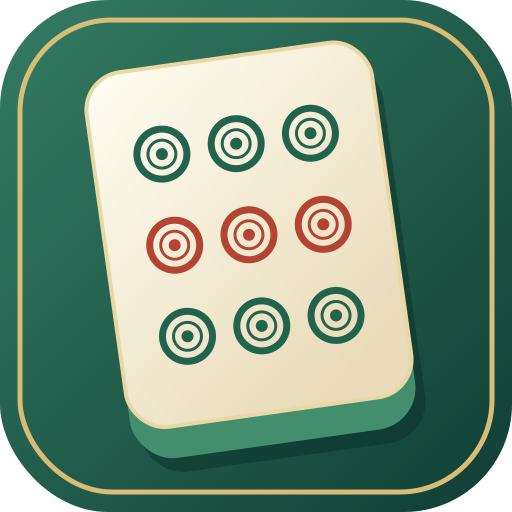
A bamboo tile remains: you cannot win. Discard missing-suit tiles first.
✓ Requirement met
✓
Bamboo cleared
No missing-suit tiles remain. You still need a legal hand; chow is not allowed.
These diagrams explain one requirement at a time, not a complete winning-hand check.
These guides describe the rules played on mahjchina. Local Mahjong rules vary; check the room settings before you start. Learn to play →
A regular hand, explained
4 sets +1 pair =14 tiles
Sequence
Characters
Sequence
Characters
Sequence
Dots
Triplet
Dots
Pair
Characters
This illustrates the tile structure only. A complete shape must also satisfy the winning requirements of the chosen game. Kongs count as sets but contain four tiles.
One turn, three decisions
01
→
Draw
Take a tile from the wall.
02
Choose
Keep useful groups together.
03
Chosen discard
Discard
Place one tile face up.
A cropped hand illustrates an ordinary draw-and-discard turn. Calls and replacement draws follow their own rules.
Four building blocks
Sequence
Three consecutive numbers, one suit.
Triplet
Three identical tiles.
Kong
Four identical tiles; draw a replacement.
Pair
Two identical tiles.
Three suits and a missing suit
Sichuan Blood Battle uses 108 tiles: characters, dots and bamboo, without winds, dragons or flowers. On mahjchina there is no three-tile exchange. Choose a missing suit before play and discard those tiles first while you still hold them.
Winning does not end the hand
You cannot win while still holding your missing suit. Chow is unavailable. Several players may win on the same discard; winners stop taking turns. The hand continues until three players have won or the wall runs out.
Self-draw example
For an ordinary self-draw with base 1 and no roots, collect 2 from each opponent who has not already won. With four players still active, the changes are +6, −2, −2, −2 in private-room points. Coins pay a fixed game entry fee; wins and losses change competitive points, not coins.
What happens when the wall is empty
The end of the wall can trigger ready-hand payments, missing-suit penalties and kong refunds. A hand without a winner can still change your balance. Check the room options and the separate settlement items, especially after declaring a kong.
Chow is not allowed in mahjchina’s Sichuan profile. Before winning, the hand must contain no tiles of the chosen missing suit. Four sets and a pair alone do not satisfy every winning condition.
Why are previous kong payments missing from the result?
This calculator scores one winner under the selected conditions. Earlier kong transfers and payments to previous winners are separate; the displayed result is not a complete blood-battle settlement.
Winning conditions, calls, draws and settlement for this ruleset.
Sichuan blood battle: choose a missing suit
Use 108 tiles in characters, dots and bamboo. There is no three-tile exchange and no chow. Choose a missing suit before play; choices are revealed after all four players choose. Discard that suit first while you still hold it. You cannot win while holding it, or pung or kong that suit.
Turns and multiple winners
Winning takes priority over pung and kong; several players may win on one discard. Winners stop drawing and discarding and no longer pay for ordinary wins or kongs. The hand ends after three winners or an exhausted wall.
Passing and robbing a kong
After passing a win, you must draw a tile yourself or be offered a win with a higher total gain before you can win again. Passing a pung blocks that tile until your next draw. An added kong can be robbed; a pending kong is not a confirmed payment. Pung and kong are unavailable when the wall is empty.
Read the win score
Scoring uses the best combination of base pattern and roots, with base points capped at 8. Results show base points, roots, payment per opponent and all four deltas. Event bonuses follow the room cap option. Example: an ordinary self-draw with base 1 and no roots collects 2 from each opponent who has not won. With all four still playing, the deltas are +6, −2, −2, −2. If one opponent has already won, they are +4, −2, −2, 0.
Kongs and an empty wall
An exposed kong collects 2 from the discarder. A concealed kong collects 2 from each other player who has not won; an added kong collects 1 each. An empty wall can trigger kong refunds, ready-hand payments and three-suit penalties. Ready-hand payments use the highest possible winning base score. A player still holding all three suits pays 8 to each recipient allowed by the room option. These adjustments can occur even if someone already won earlier in the hand.
Four room options
Private room options determine whether event fan share the cap; whether only non-ready players or all non-winners refund kongs; whether refunds include all original payers; and whether three-suit penalties go to all other seats. The last two alternatives can include earlier winners as an exception for end-of-hand adjustments. See room details for the selected rules.
Dealer rotation in friend rooms
In friend rooms, the first winner deals next; if nobody wins, the dealer stays. An exhausted wall still counts as a hand. Hand scores accumulate into the match total.
Value
mahjchina Sichuan profile: no chow, clear the missing suit, root-adjusted base capped at 8. Self-draw normally pays base + 1 from each active opponent; previous kong transfers are separate. Rule choices & sources →
Clear the missing suit; pung and kong are allowed, chow is not. Table values are bases, not MCR points or Riichi han. Each root (four identical tiles, including kongs) doubles the base, capped at 8. Dragon Pairs roots use the same calculation.
With root-adjusted base B: discard B; self-draw B+1; rob kong, discard after kong or last discard 2B; last draw 2B+1; kong draw 4B+1. Exposed-kong draw is paid only by that kong’s discarder; other self-draws charge active opponents.
By default only the base is capped. Event-cap mode limits discard to 8 and self-draw to 9. Heavenly/Earthly hands use base 8; last-tile and kong events can combine. Prior kong payments, draw-ready checks, missing-suit penalties and kong refunds are outside this single-win calculation.
Hand scoring calculator
Choose concealed tiles and melds. The last concealed tile is the winning tile. Patterns are detected using the game’s scoring engine.
Calculated on this device. The scoring engine downloads on first use.
Calculates one winner. Earlier kong payments, simultaneous winners, draw penalties and competitive points are not included. This is not server authorization to win.
Calculators show rule scores, not competitive points or rank stars.
Rule units, not coins
Regular hands and useful comparisons
Compare a regular self-draw, the same hand missing one tile, and the same complete hand won on a discard. Load any example to inspect or change its settings.
Regular self-draw
Called sets are shown separately. All other settings start at the calculator defaults.
This is the same hand and default settings used by Load example. The last tile shown is the winning tile. Load it above and calculate to check the result.
No exposed sets; self-draw; East seat; no flowers or special events. Other special options are off. The missing suit is bamboo; all three opponents are still active.
1m 1m 1m 2m 2m 2m 3p 3p 3p 4p 4p 4p 5m 5m
Scoring breakdown
All triplets · 2
All Triplets base 2, no roots. Self-draw payment is 2 + 1 = 3 per active opponent; winner receives 9 points.
These are this game’s rules. Exclusions, repeated sets and concealed-hand conditions affect combinations: do not simply add table values. The calculator selects a valid interpretation.
Detected patterns
Value · base
Requirement
Standard hand
1
Missing suit cleared; a regular four-set-and-pair win.
All triplets
2
Every set is a pung or kong, plus a pair.
Pure suit
4
Only one numbered suit, with no honors.
Pure triplets
8
One suit, all pungs/kongs and a pair.
Golden hook
4
Four declared pungs/kongs, leaving only the pair in hand.
Pure golden hook
8
Golden Hook with only one suit.
Seven pairs
4
Seven pairs, with no melds. In this profile, four identical tiles may form two pairs.
Pure seven pairs
8
Seven pairs in one suit.
Dragon seven pairs
4
Seven pairs containing four identical tiles; root doubling is applied separately.