Discover Mahjong
What Is Mahjong? Meet the Tiles and the Table
Mahjong brings four players together around a set of tiles. You draw, discard and build a hand while watching what the other players reveal. A little luck changes the tiles; your choices shape the game.
Learn your first handBuild a hand, one decision at a time
Each player keeps a hand of tiles. On an ordinary turn you draw one tile, then discard one. Your aim is to form the combinations needed for a legal win in your chosen ruleset. Other players’ discards and exposed groups give you clues; their concealed tiles remain hidden.
Meet the tile families
Start with the three numbered suits. Each runs from 1 to 9, and each tile normally has four copies. Some rulesets also use honor and flower tiles. Designs vary between sets; these symbols are a first introduction.
Characters
Often called “wan” or “cracks”. Look for the number above the character 萬.
Dots
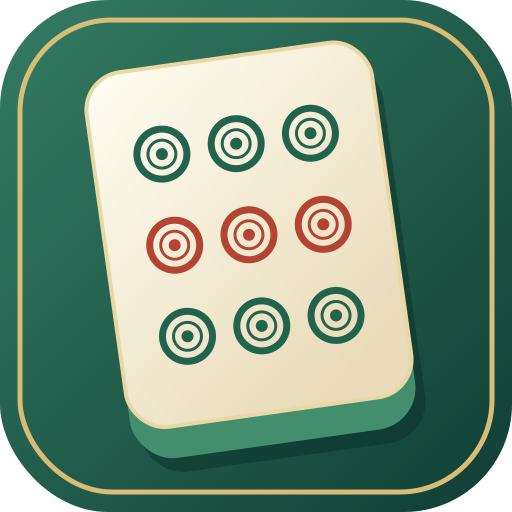
Also called circles or “pin”. Count the circular marks to read the number.
Bamboo
Also called “sou” or “bams”. Most show bamboo sticks; the 1 often shows a bird.
Honors
East, South, West and North winds, plus red, green and white dragons. They have no numerical sequence.
Flowers
Special tiles used by some rulesets. In our Hong Kong, MCR and Taiwanese games they are exposed and replaced.
Tile names, codes and counts
Numbered tiles have three suits: characters (m), dots (p) and bamboo (s), each numbered 1–9 with four copies. That makes 108 numbered tiles. In the calculator, 3m means three characters; 7p means seven dots.
Honors are East, South, West, North and the red, green and white dragons: seven types with four copies each. With the numbered tiles they make a 136-tile core. Flowers, seasons and other additions depend on the ruleset; mahjchina Sichuan uses the 108 numbered tiles.
A sequence uses three consecutive numbers in one suit, such as 2p 3p 4p. Honors cannot form sequences. Four players sharing tiles have different goals from Mahjong solitaire’s pair-removal puzzle.
The shape of a hand
In four of the five games here, the regular shape is four sets and one pair: 14 tiles at the winning moment, before extra kong tiles. Taiwanese Mahjong uses five sets and one pair: 17 tiles. Special hands and minimum scoring requirements depend on the ruleset.
Learn your first hand →Mahjong and Mahjong solitaire
This site teaches the four-player game of drawing, discarding and forming hands. Mahjong solitaire is a different game in which you remove matching tiles from a layout. If that is the Mahjong you know, start with the tile families above and try our first-hand guide.
Chinese roots, many ways to play
Mahjong developed in China during the Qing dynasty. Learning a new variant is also a chance to discover different names, customs and approaches to play. Our five guides are a starting point, not a catalogue of every Mahjong tradition.
These objects help us see Mahjong as more than a rulebook: it is also a game people have made, kept and shared.
Sources behind this introduction
Historical reference: Smithsonian National Museum of American History
- I'm betting on Numismatics!
Jennifer Gloede · November 15, 2017. Supports the Qing-dynasty origin and tally-stick background.
https://americanhistory.si.edu/explore/stories/im-betting-numismatics ↗ - Mah Jong Set
Collection record 2006.0098.1475. Supports the description of bamboo, celluloid and wood.
https://americanhistory.si.edu/collections/object/nmah_1346420 ↗